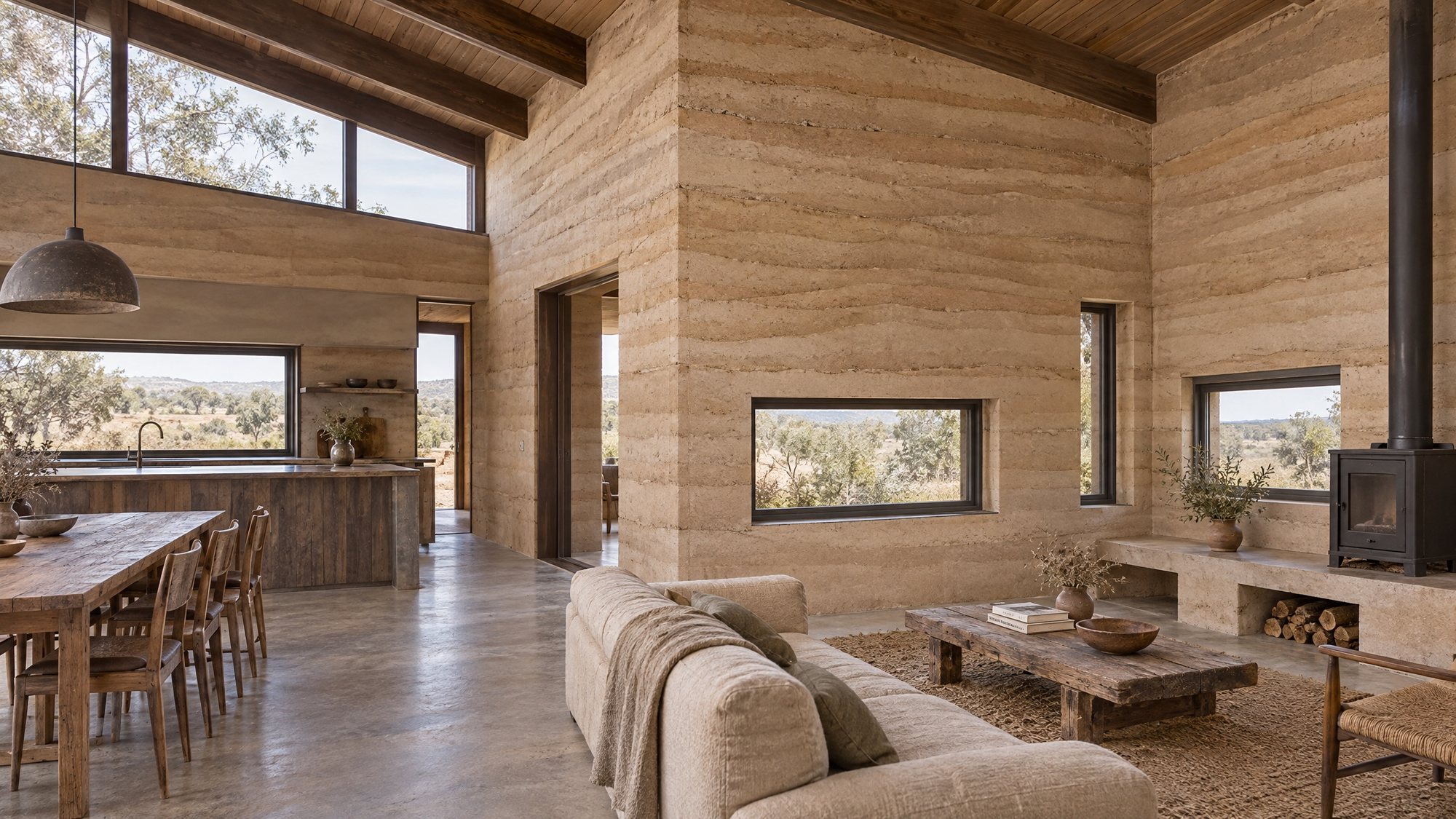
Of everything that goes into a building, materials are what I think about most. They decide how a house feels to live in, how long it lasts, and how much carbon was spent before anyone moved in. Some of the best answers I have found are also the oldest: walls made from the ground they stand on. Mud brick, rammed earth and clay plaster are coming back as sustainable building materials in Australia, and it is worth being clear about what they do well and where they fall short.
01A history of mud brick and rammed earth, close to home
Sun-dried mud brick, rammed earth, cob and earth plaster have been used for thousands of years. The tower houses of Shibam in Yemen, many storeys of mud brick, date largely from the 16th century 1.
Melbourne has its own version of this story. At Montsalvat in Eltham, artists were building in stone and pisé de terre (rammed earth) in the 1930s. After the war, with conventional materials scarce and expensive, Alistair Knox started making mud-brick houses from Eltham’s clay in about 1947. He designed more than 600 houses over his career 2. Plenty of them are still lived in.
02Earth building and embodied carbon
Cement production accounts for around 8 per cent of global carbon dioxide emissions 3. The carbon released in making materials is called embodied carbon, and it is spent before a house is lived in (see our Sustainability page). Unfired earth needs very little processing: it is dug, mixed, formed and left to dry, often on or near the site.
One qualification. Most modern rammed earth in Australia is stabilised with a small proportion of cement for strength and weathering. That makes it lower-carbon than a concrete or fired-brick wall, but not carbon-free.
03Thermal mass vs insulation in rammed earth walls
This is the point I most want to get right, because it is often oversold. A thick earth wall has high thermal mass: it absorbs heat slowly and gives it back slowly, which evens out the swing between a hot afternoon and a cool night. Insulation does a different job. It slows heat passing through the wall, and on that measure solid earth is weak.
Laboratory testing cited in an Adelaide study put the thermal resistance of a rammed earth wall at about 0.4 m²K/W. The same study found uninsulated rammed earth houses performed about as well as an insulated one in summer, but could be up to 5°C cooler in winter 4.
Earth plus insulation, not earth instead of insulation.
Climate decides how much this matters. Simulations of naturally ventilated houses with 300 mm rammed earth walls gave these results 5:
| Climate | Uninsulated | With 30 mm insulation |
|---|---|---|
| Hot arid | about 77% | about 89% |
| Warm temperate | about 68% | about 90% |
| Cool temperate | about 45% | about 58% |
A companion study found that uninsulated rammed earth houses could meet Australian energy requirements in hot arid and warm temperate climates with careful passive design, but not in a cool temperate climate 6. Melbourne sits much closer to the bottom row than the top.
04How clay walls regulate indoor humidity
Unfired clay absorbs moisture when the air is humid and releases it when the air is dry. Across more than 100 clay blocks and plasters tested, clay regulated humidity far better than conventional building materials, and the choice of soil mattered more than anything added to it 7.
For health, steadier humidity is useful at both ends. Persistent damp and mould in homes are linked with respiratory and asthma symptoms 8, and very dry air is associated with eye and airway irritation 9. Clay will not fix a leak or replace ventilation. A clay plaster over an ordinary wall does, though, give some of this benefit on its own.
05Earth homes and Australian building rules (NCC and NatHERS)
Since NCC 2022, new homes have needed a minimum thermal performance equivalent to seven stars under NatHERS 10. With low insulation values, earth walls usually need careful modelling, added insulation, or both to get there.
Earth, straw bale and hempcrete also fall mostly outside the code’s standard deemed-to-satisfy routes. They are generally approved as performance solutions, one project at a time, so a lot depends on the building surveyor, the council and local precedent 11. The main Australian reference, Standards Australia’s Australian Earth Building Handbook, dates from 2002 12.
I would like to say the standards are catching up. The honest answer is: slowly. The star rating counts the energy a house will use for heating and cooling, not the carbon in the materials it is built from, which is where earth does best. In October 2025, building ministers agreed that embodied carbon provisions would be published only as voluntary guidance, and that there would be no further residential changes to the NCC until mid-2029, other than essential quality and safety measures 13. The path to approval exists. It just takes more work than it should.
06How to start an earth building project
- See the surveyor first. Before the design is fixed, find out what they will need to approve an earth wall.
- Choose people who have done it. A designer and builder with finished earth projects you can visit.
- Model for your climate. In Melbourne and cooler areas, design the insulation in from the start.
- Start small if unsure. An internal mass wall or clay plaster brings some of the benefit without the full approval process.
- Measure it afterwards. A season of temperature and humidity logging shows how the house really performs.
We assess materials, temperature and humidity as part of our Materials and Thermal environment work, and we review plans for earth and other natural-material buildings before they go to council.
References
- UNESCO World Heritage Centre. Old Walled City of Shibam. Accessed March 2026. whc.unesco.org/en/list/192/
- Goldlust R. Alistair Knox (1912-1986) and the birth of environmental building in Australia. Arcadia (Environment & Society Portal). 2016;(18). www.environmentandsociety.org/arcadia/alistair-knox-1912-1986-and-birth-environmental-building-australia
- Lehne J, Preston F. Making concrete change: innovation in low-carbon cement and concrete. London: Chatham House; 2018. www.chathamhouse.org/2018/06/making-concrete-change-innovation-low-carbon-cement-and-concrete
- Soebarto V. Analysis of indoor performance of houses using rammed earth walls. Proceedings of Building Simulation 2009, 11th International IBPSA Conference. Glasgow; 2009:1530-1537. publications.ibpsa.org/proceedings/bs/2009/papers/bs2009_1530_1537.pdf
- Dong X, Soebarto V, Griffith M. Achieving thermal comfort in naturally ventilated rammed earth houses. Build Environ. 2014;82:588-598. doi.org/10.1016/j.buildenv.2014.09.029
- Dong X, Soebarto V, Griffith M. Strategies for reducing heating and cooling loads of uninsulated rammed earth wall houses. Energy Build. 2014;77:323-331. doi.org/10.1016/j.enbuild.2014.03.031
- McGregor F, Heath A, Shea A, Lawrence M. The moisture buffering capacity of unfired clay masonry. Build Environ. 2014;82:599-607. doi.org/10.1016/j.buildenv.2014.09.027
- Fisk WJ, Lei-Gomez Q, Mendell MJ. Meta-analyses of the associations of respiratory health effects with dampness and mold in homes. Indoor Air. 2007;17(4):284-96. doi.org/10.1111/j.1600-0668.2007.00475.x · PubMed 17661925
- Wolkoff P. Indoor air humidity, air quality, and health: an overview. Int J Hyg Environ Health. 2018;221(3):376-390. doi.org/10.1016/j.ijheh.2018.01.015 · PubMed 29398406
- Australian Building Codes Board. NCC 2022 residential energy efficiency: overview of provisions. Canberra: ABCB; 2022. www.abcb.gov.au/sites/default/files/resources/2022/NCC-2022-Residential-Energy-Efficiency-Overview-of-Provisions-Text-Transcript_0.pdf
- Natural Building Australia. Natural materials and the NCC (National Construction Code): an outline. 18 July 2023. naturalbuildingaustralia.org/2023/07/18/natural-materials-and-the-ncc-national-construction-code-an-outline/
- Walker P, Standards Australia. HB 195-2002 The Australian earth building handbook. Sydney: Standards Australia; 2002. www.intertekinform.com/en-au/standards/hb-195-2002-131125_saig_as_as_277783/
- Building Ministers’ Meeting. Meeting communiqué: Building Ministers’ Meeting, October 2025. Canberra: Australian Government Treasury; 2025. treasury.gov.au/media-release/meeting-communique-building-ministers-meeting-october-2025